
Table of Contents
- Why 4 Days from Marrakech is the Sweet Spot
- What You’ll See: Overview of the Route
- Day 1 – Marrakech to the Atlas Mountains & Ait Ben Haddou
- Day 2 – Dades Valley, Todra Gorge & the Sahara Desert
- Day 3 – Sunrise in the Sahara & the Road Back West
- Day 4 – Return to Marrakech (or Continue to Fes)
- Which Route is Right for You?
- Practical Tips Before You Go
- Why Book With Go Sahara Morocco?
- Frequently Asked Questions
Why 4 Days from Marrakech is the Sweet Spot
You have four days. You’re standing in Marrakech—already in love with the souks, the call to prayer echoing across the rooftops, and the smell of cumin and rose water in every narrow lane. But you know that the real Morocco is further out. You’ve seen the photos. The orange dunes. The camel silhouettes at dusk. The Milky Way arching over a Berber tent.
The question is, can you actually get there and back in 4 days without it feeling rushed?
The honest answer is yes — but only if you plan it right.
At Go Sahara Morocco, we’ve been running desert itineraries since 2015 and completed over 1,200 tours. We’ve learned that 4 days is the ideal window for most travelers. Here’s why:
- 2-day tours barely get you to the desert. You spend most of it on the road, arriving exhausted.
- 3-day tours work, but the pace is tight. You sacrifice stops like Todra Gorge or Rissani market.
- 4-day tours give you everything: the Atlas Mountains, a UNESCO kasbah, two dramatic gorges, a full sunset camel trek, a luxury night under the stars, and a relaxed return.
- 7-day tours are wonderful if you have the time — but most travelers don’t.
Four days is the Goldilocks duration. Not rushed. Not excessive. Just right.
“We did 4 days with Go Sahara Morocco and honestly could not have fit more magic into that time. Every stop felt intentional, never hurried.” — Lena K., Germany
What You’ll See: Overview of the Route
Before we break it down day by day, here’s the big picture of what a classic 4 days tour from Marrakech covers:
| Day | Route | Highlights |
|---|---|---|
| Day 1 | Marrakech → Atlas → Ait Ben Haddou → Ouarzazate | Tizi n’Tichka pass, UNESCO kasbah, “Morocco’s Hollywood” |
| Day 2 | Ouarzazate → Dades → Todra → Merzouga | Rose Valley, towering gorge walls, camel trek, luxury camp |
| Day 3 | Merzouga → Rissani → Draa Valley → Ouarzazate | Sahara sunrise, sandboarding, ancient market, palm oasis |
| Day 4 | Ouarzazate → Marrakech (or → Fes) | Atlas return, optional Ait Ben Haddou revisit |
Total driving: approximately 1,100 km across 4 days, broken into comfortable 4–6 hour daily segments with scenic stops every 60–90 minutes.
All tours depart from Marrakech at 8:00am and include a private air-conditioned vehicle, an English-speaking Berber guide, 3 nights accommodation, daily breakfast and dinner, a camel trek, and sandboarding.
👉 View the full 4-day trip from Marrakech to Sahara Desert here
Day 1 – Marrakech to the Atlas Mountains & Ait Ben Haddou
Route: Marrakech → Tizi n’Tichka → Ait Ben Haddou → Ouarzazate Driving time: ~4 hours with stops Overnight: Traditional riad, Ouarzazate
Your driver meets you at your Marrakech hotel or riad at 8am. Within 30 minutes, the city dissolves and the road begins climbing into the High Atlas Mountains.
Tizi n’Tichka Pass (2,260m)
This is Morocco’s highest paved mountain road — and one of the most cinematic drives in North Africa. Hairpin bends, Berber villages clinging to cliffsides, panoramic valleys opening up below you. Stop at the summit for photos and a glass of mint tea at a roadside café. Your guide will point out Glaoui kasbahs half-buried in the hillsides, remnants of the feudal lords who once controlled this mountain passage.
Pro tip from Go Sahara Morocco: Sit on the right side of the vehicle for the best views on the ascent.
Ait Ben Haddou — UNESCO World Heritage Site
Descending into the pre-Saharan south, you’ll reach the fortified village of Ait Ben Haddou — arguably the most photographed site in Morocco and a UNESCO World Heritage site since 1987.
This ancient ksar (fortified village) has appeared in more films and TV productions than almost anywhere on earth: Gladiator, Game of Thrones, Lawrence of Arabia, The Mummy, Babel. Walking through its earthen towers and labyrinthine alleys, it’s easy to understand why directors keep returning.
Spend 60–90 minutes exploring the upper kasbah for panoramic views over the valley and the palmery. Cross the river on stepping stones (or a small bridge in winter).
- Entrance fee: €5 per person (not included in tour price)
- Best photo spot: The elevated terrace at the top of the ksar, looking back toward the river
Ouarzazate — “The Door of the Desert”
Your first night is in Ouarzazate, a laid-back city with wide avenues and an easy pace that feels worlds away from Marrakech’s intensity. Often called “Morocco’s Hollywood” for its world-class Atlas Film Studios (the largest film studios in the world), it’s a great place to stretch your legs after the drive.
Dinner is included at your riad. Sleep comes easily.
Day 2 – Dades Valley, Todra Gorge & the Sahara Desert
Route: Ouarzazate → Roses Valley → Dades Gorge → Todra Gorge → Merzouga Driving time: ~6 hours with stops Overnight: Luxury Berber camp, Erg Chebbi dunes
This is the day that changes everything. By the time you climb your camel at sunset, you’ll understand why people say Morocco never leaves you.
The Valley of a Thousand Kasbahs
The road east from Ouarzazate winds through the Draa and Dades valleys — a landscape of crumbling mud-brick kasbahs, flowering rose gardens (best in April–May), and ancient qsars rising above ribbons of green palmery. Your guide will stop at one or two of the most photogenic villages along the way.
This region supplies 90% of the world’s rose water — the air in spring literally smells of flowers.
Todra Gorge
At the eastern end of the Dades Valley, the landscape suddenly tightens into the dramatic Todra Gorge. Two walls of rose-colored limestone rise 300 meters on either side of a narrow riverbed, leaving only a sliver of sky above. A short walk through the gorge is one of the most physically impressive experiences of the entire tour.
- Entry: Free
- Recommended time: 30–45 minutes
- Good for: Photography, short walks, spotting rock climbers on the walls
Arriving at the Sahara — Merzouga & Erg Chebbi
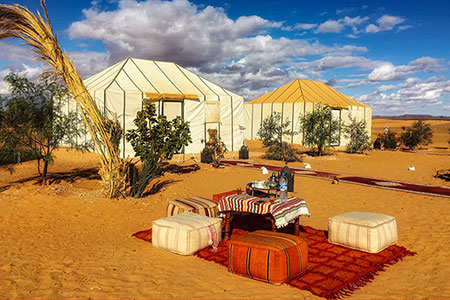
By late afternoon you’ll reach the village of Merzouga, and for the first time you’ll see them: the dunes. The Erg Chebbi dune field rises to 150 meters — ochre, rust, and deep gold depending on the light — stretching south along the Algerian border as far as the eye can see.
You’ll be handed a Berber scarf to wrap around your head. Your camel is waiting.
Sunset Camel Trek
The 60-minute camel trek into the heart of the dunes is one of those experiences that defies description. The silence deepens with every step away from the road. The dunes shift colors every few minutes as the sun drops. Your guide leads you to a high ridge overlooking the camp just as the last light fires the horizon.
This is why you came.
Luxury Berber Camp
Your camp for the night is not a tent in the Western sense. Go Sahara Morocco partners exclusively with properly equipped luxury camps: private furnished tents with real beds and linens, hot showers, a communal dining tent, and a fire circle for the evening.
After dinner (a full Moroccan spread — tagine, salads, bread, mint tea), your guide and the camp musicians play gnawa and Berber music around the fire. The stars above Erg Chebbi are extraordinary — there is essentially zero light pollution.
👉 See everything included in our 4-day Merzouga tour
Day 3 – Sunrise in the Sahara & the Road Back West
Route: Merzouga → Rissani → Draa Valley → Agdz or Ouarzazate Driving time: ~5 hours with stops Overnight: Guesthouse or riad, Draa Valley
Sahara Sunrise
Wake before dawn. This is non-negotiable. The sunrise over Erg Chebbi—watching the dunes shift from deep purple to rose gold to blazing amber in 20 minutes— is among the most breathtaking natural spectacles in the world. No photograph does it justice. Be there.
After sunrise, sandboard down the dunes. It’s harder than it looks and more fun than almost anything else on the itinerary.
Rissani Market
Back in the village, visit the ancient town of Rissani — birthplace of Morocco’s ruling Alaouite dynasty and home to one of the most authentic weekly markets in the south. Even outside market days, the covered souk is alive with spice sellers, argan oil cooperatives, and date merchants (Rissani dates are considered the finest in Morocco).
Your guide can introduce you to local artisans whose families have worked here for generations. This is the kind of access that makes small-group tours with Go Sahara Morocco different from large bus operators.
The Draa Valley Return
The long afternoon drive back west through the Draa Valley is more gift than obligation. Morocco’s longest valley stretches 40 kilometers through an unbroken ribbon of dates, with kasbahs emerging from the palms at every bend. The late afternoon light turns everything amber and gold.
Overnight in Agdz or Ouarzazate — your guide will recommend the best guesthouse based on availability.
Day 4 – Return to Marrakech (or Continue to Fes)
Route Option A: Ouarzazate → Ait Ben Haddou → Marrakech (arrival ~5pm) Route Option B: Merzouga → Middle Atlas → Ifrane → Fes (arrival ~1pm)
Option A: Return to Marrakech
The return drive follows a similar arc to Day 1 — back over the Atlas, with a second stop at Ait Ben Haddou if you want more time (many travelers find they appreciate it more the second day, with less tour-group pressure in the morning). You will be back in Marrakech by late afternoon and dropped directly at your hotel.
You have the evening free for a final dinner in the medina — we recommend the rooftop restaurants around Jemaa el-Fna square for a last look at the city from above.
Option B: Continue to Fes — The One-Way Grand Route
If you’re not flying out of Marrakech, this is the smarter choice. Instead of retracing your steps, you push north from Merzouga through an entirely different Morocco: the cedar forests of the Middle Atlas, the alpine town of Ifrane (nicknamed “Morocco’s Switzerland”), and down into the ancient imperial city of Fes.
Arrive in Fes by early afternoon — enough time to check into your riad in the medina and explore the Chouara tanneries before sunset.
This route covers the entire width of Morocco in 4 days and is one of the most geographically complete travel experiences available in North Africa.
👉 Explore the full Marrakech to Fes 4-day route
Which Route is Right for You?
Not sure which version of this itinerary fits your trip? Here’s a quick decision guide:
| Your Situation | Best Route |
|---|---|
| First time in Morocco, flying in and out of Marrakech | Classic Merzouga loop, return Day 4 |
| Continuing to Chefchaouen or flying from Fes | Marrakech → Merzouga → Fes one-way |
| Tighter budget, shorter on time | Marrakech → Zagora loop (2 nights) |
| Photographer or nature lover | Classic Merzouga — best dunes and light |
| Family with young children | Zagora route — shorter driving days |
| Couple celebrating a milestone | Private Merzouga tour with luxury camp upgrade |
For a full side-by-side breakdown of every option — including Zagora, Merzouga, and the Fes route — visit our complete 4 days tour from Marrakech guide.
And if you want to explore the full range of what’s possible from Marrakech — from 2-day escapes to 10-day grand circuits — our tours from Marrakech page covers every option with transparent pricing.
Practical Tips Before You Go
These are the real-world details that most travel blogs skip. After 1,200+ tours, the Go Sahara Morocco team has heard every question. Here are the answers to the ones that matter most:
What to Pack
- Layers — desert nights drop to 0–5°C in winter, 10–15°C in spring/autumn
- Wide scarf or shemagh — sun protection, sand barrier, and surprisingly useful pillow substitute
- Sunscreen SPF 50+ and UV sunglasses — the desert sun at altitude is intense
- Power bank (20,000 mAh recommended)—charging in the luxury camp is available but shared
- Comfortable walking shoes — you don’t need hiking boots, but sandals aren’t ideal on dunes
- Small daypack — leave large suitcases at your Marrakech hotel
Best Time to Go
- October–November & March–April: Perfect temperatures (20–25°C days, 10–15°C nights). Best overall.
- December–February: Fewer tourists, lower prices, extraordinary stargazing. Cold nights — pack accordingly.
- June–August: Very hot (38–42°C). Camel treks move to 5am sunrise. Only recommended if you genuinely love heat.
Getting to the Start Point
All Go Sahara Morocco tours depart directly from your Marrakech accommodation. There’s no need to reach a separate meeting point—your driver picks you up at your hotel or riad at 8:00am on Day 1.
Dietary Requirements
Moroccan cuisine is naturally vegetarian-friendly. Tagines, couscous, harira soup, and fresh salads are available everywhere. With advance notice, we can easily accommodate vegan options. Always mention dietary requirements at booking—we confirm with every camp and guesthouse along your specific route.
Solo Female Travelers
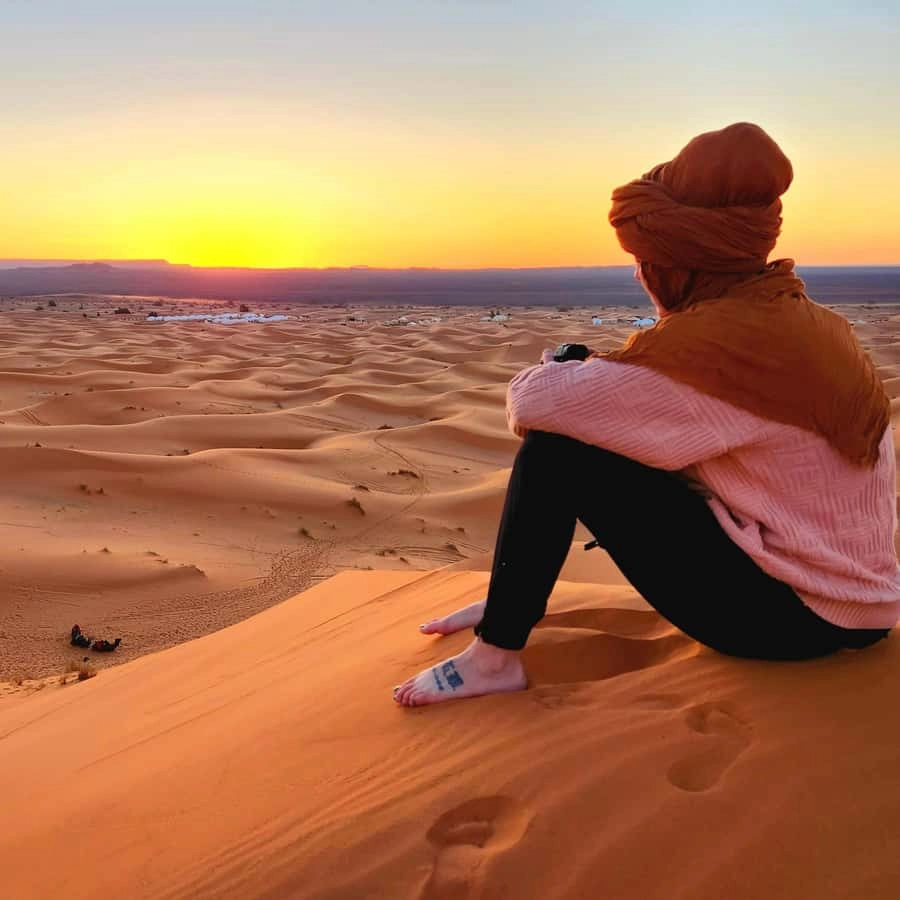
This is one of our most frequently asked questions, and the answer is an unequivocal yes — our tours are safe and comfortable for solo female travelers. All guides are licensed, vetted, and experienced. Small groups (maximum 8 people) mean you’re never isolated. We’ve guided hundreds of solo women without a single safety incident.
Why Book With Go Sahara Morocco?
There are dozens of operators offering desert tours from Marrakech. Here’s what makes Go Sahara Morocco genuinely different — not as a marketing claim, but as a verifiable fact:
We are local. Our team is based between Marrakech and Merzouga. The desert isn’t a product we sell from abroad—it’s the landscape our guides grew up in. When your guide tells you a story about a particular dune or a village elder, it comes from lived experience, not a script.
We keep groups small. Maximum 8 travelers per group. This isn’t just a comfort choice—it means your guide can give real attention to every person, adjust the pace when needed, and take you to places that a 40-seat coach simply cannot reach.
We are transparent about cost. Our pricing page lists exactly what’s included and what isn’t. No surprise bills at the end of the tour, no commission-based restaurant stops, no inflated “optional” activities pushed on travelers.
We have the reviews to prove it. Rated 4.9/5 across 340+ Google Reviews. Unmanaged reviews— real feedback from real travelers that you can read and verify independently.
We’ve done this 1,200+ times. Since 2015, we’ve refined every route, every camp partnership, and every stop timing based on real traveler feedback. The itinerary you read above isn’t a guess—it’s the product of a decade of iteration.
👉 Browse all our tours from Marrakech or go straight to booking the 4-day Sahara trip.
Frequently Asked Questions
How far is the Sahara from Marrakech? The Erg Chebbi dunes near Merzouga are approximately 550 km from Marrakech — roughly 9–10 hours of pure driving. That’s why a minimum of 4 days is needed to do it properly, spreading the journey across two days in each direction with meaningful stops along the way.
Is it safe to travel to the Sahara from Marrakech? Yes. The route from Marrakech to Merzouga via Ouarzazate is one of the most well-traveled tourist roads in Morocco, with good infrastructure, regular petrol stations, and reliable mobile coverage for most of the journey. Go Sahara Morocco maintains daily check-ins with our Marrakech office throughout every tour.
What is the best month for a 4-day desert tour from Marrakech? October, November, March, and April offer the best balance of comfortable temperatures, manageable crowds, and ideal photography light. December through February is excellent for those who don’t mind cold nights and prefer quieter dunes.
Do I need a visa to visit Morocco? Citizens of the EU, UK, USA, Canada, and Australia do not require a visa for stays under 90 days. Always check your specific country’s requirements before traveling, as policies can change.
Can I extend the tour to 5 or 6 days? Absolutely. Go Sahara Morocco offers customized itineraries of any length. Common extensions include an extra night in Merzouga for a multi-dune exploration, or adding Todra Gorge hiking to a Zagora itinerary. Contact us via WhatsApp for a personalized quote.
What happens if I get sick or the tour needs to be cancelled? Free cancellation is available up to 7 days before departure. For medical emergencies during the tour, our guides are first-aid trained and our Marrakech office provides 24-hour support. We strongly recommend purchasing travel insurance that covers medical evacuation before departure.
Final Thoughts
Four days. That’s all it takes to go from the spice-scented labyrinth of Marrakech to the edge of the world’s greatest desert — crossing a UNESCO World Heritage site, two dramatic mountain gorges, a valley of ancient kasbahs, and 150-meter dunes along the way.
It is, without exaggeration, one of the most geographically varied and visually spectacular short itineraries available anywhere on earth.
Go Sahara Morocco has spent a decade making sure every one of those four days is worth the journey. We’d be honored to show you our desert.
👉 Book your 4-day tour from Marrakech — reserve with a €50 deposit, pay the rest on arrival. Free cancellation up to 7 days before departure.
Written by the Go Sahara Morocco team — local Berber guides and desert specialists based in Marrakech and Merzouga, Morocco. Operating since 2015.