

Full-Day Private Guided Experience
Marrakech City Tour Guide
With a professional Marrakech city tour guide from Go Sahara Morocco, you can see the lively heart of Morocco. This guided tour takes you through the historic Medina of Marrakech, where you can see and feel centuries of culture, architecture, and traditions. With a local guide who knows a lot about the area, you’ll see famous landmarks, secret alleys, colorful souks, and old palaces while hearing interesting stories about the Red City.
You will see some of Marrakech’s most famous sights on this unforgettable city tour, such as the Koutoubia Mosque, Bahia Palace, and the busy Jemaa el-Fnaa square. Your guide will also take you to real markets where artisans make traditional Moroccan goods. This will give you a better idea of how people in Morocco live and what their culture is like.
This private guided city tour is the best way to see the history, architecture, and lively atmosphere of Marrakech, whether it’s your first time there or you’re going back to learn more.

4.9 out of 5 Based on 339 reviews.

Duration:
Half-day (4h) or Full-day (8h)
Coverage:
Medina, Souks & New City
Group Type:
Private or Shared
Languages:
English · French · Arabic
Pickup:
Your Marrakech hotel or riad
The Destination
Your Complete Marrakech City Tour Guide: The Red City Unlocked
Marrakech is one of the world’s finest cities—not because of a single famous building or landmark, but because of the totality of the experience it delivers. A living, functioning medieval city of 1.3 million people, where the 12th-century street plan remains intact, where craftsmen still work in the same trades their great-grandfathers did, and where the main square has been declared a UNESCO oral and intangible heritage site because the storytellers, musicians, and performers who gather there every evening are themselves the monument.
Why You Need a Local Guide for Marrakech?
The medina of Marrakech is the world’s largest car-free urban area—over 18 square kilometers of interconnected alleys, squares, and covered souks that were designed, over centuries, for donkeys rather than GPS. The street layout defies navigation. Every year, thousands of travellers spend their Marrakech hours not experiencing the city but trying to escape from it, map in hand, increasingly frustrated.
A Go Sahara Morocco city tour guide makes the mood completely different. Not because they carry a flag and recite facts, but because they know which door leads to the best private madrasa courtyard in the city, which tannery viewpoint is worth the climb, which spice merchant has been in the same family for four generations, and how to read the city’s rhythms well enough to get to Jemaa el-Fna at just the right time. Casual visitors can’t see how deep the medina is. It needs someone who knows it well.
“Marrakech is one of those rare cities where the experience of being lost and being guided feel almost identical — except that with a good guide, every single thing you encounter has a story that doubles its meaning.“
— Go Sahara Morocco, Guide Perspective
The Gallerie
Photos from Our Marrakech City Tour
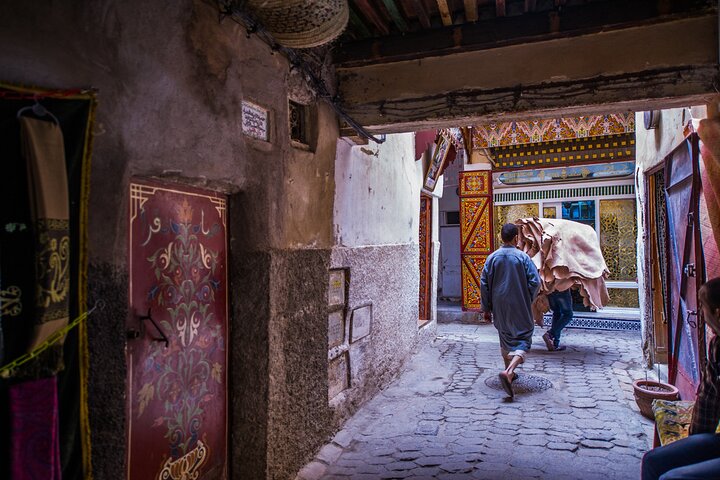
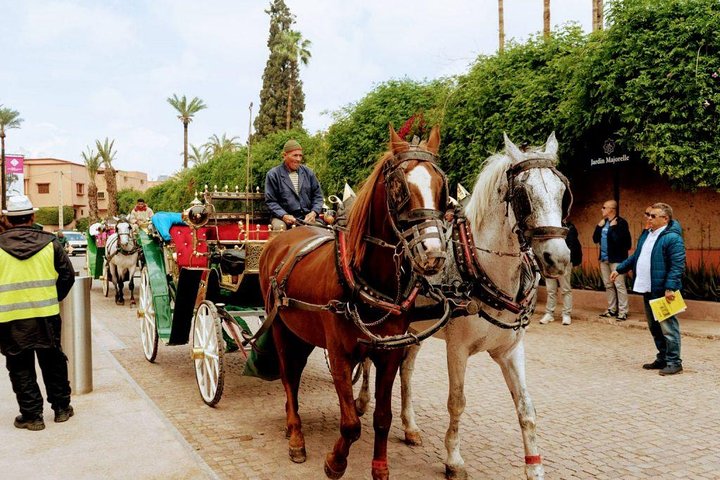
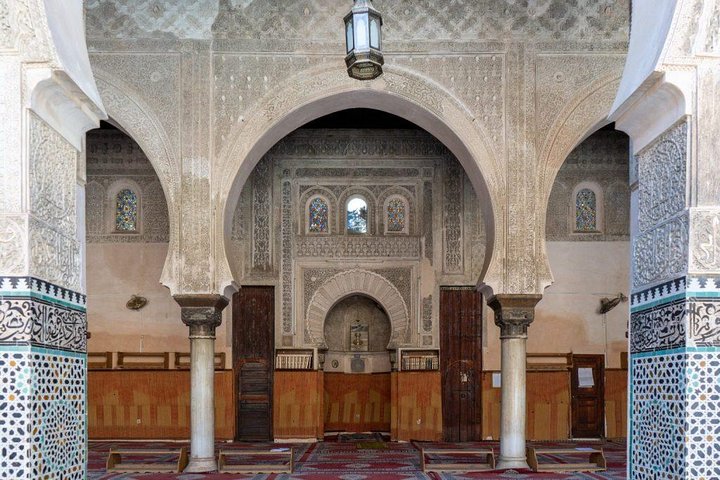
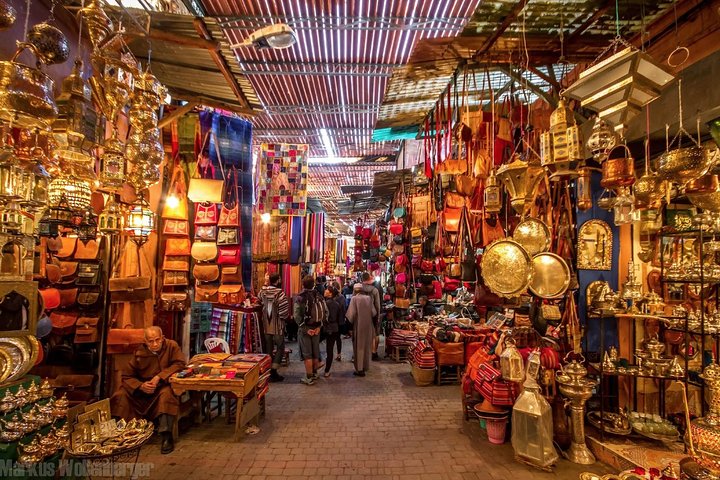
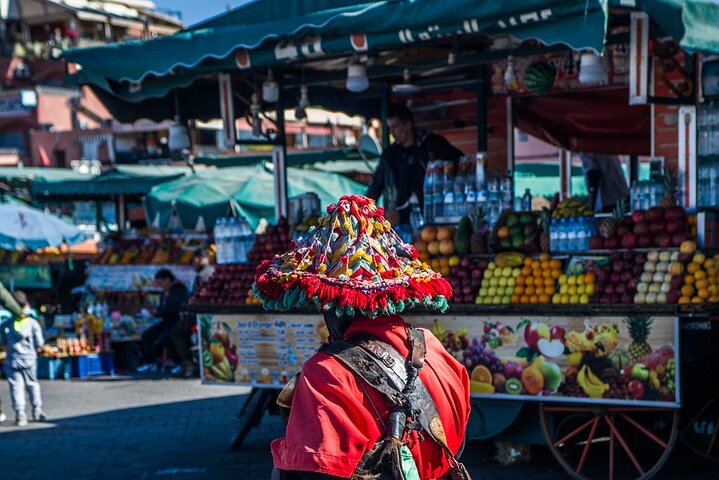
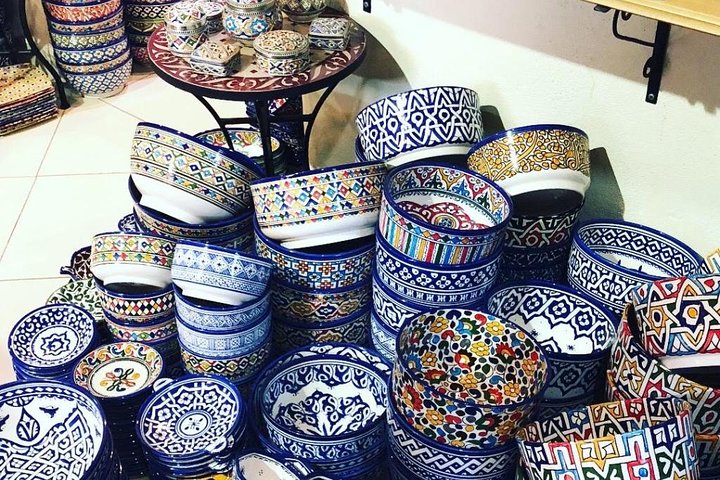
Browse the gallery below to get a glimpse of the unforgettable moments waiting for you during your Marrakech guided city tour.
Highlights in Video
Discover Marrakech in Video
The Day, Hour by Hour
Complete Marrakech City Tour Itinerary
All timings are approximate and adapt naturally to your group's pace, your interests, and the season. Private tours are structured entirely around you. Half-day options run 8 AM to 1 PM or 2 PM to 7 PM.
Your Go Sahara Morocco guide meets you directly at your riad or hotel — no assembly points, no waiting for other passengers. The morning starts with introductions, a brief orientation to the day's structure, and a mint tea if your accommodation offers it. Your guide uses this first conversation to understand your interests, photography priorities, physical comfort level, and any cultural questions you've already been wondering about. The tour is calibrated from this first exchange — not from a fixed script.
The first stop sets the direction for everything that comes after it. The Almohad dynasty built the Koutoubia Mosque in the 12th century. Its minaret was the model for the Giralda in Seville and the Hassan Tower in Rabat. Marrakech was built around it. Your guide talks about how this landmark is related to the city that grew up around it, the rules of Islamic urban planning that shaped the medina's layout, and the difference between the old medina (Marrakech el-Kadim) and the Jewish quarter (Mellah) that is next to it. This is the background that makes everything else on the tour clear.
The Ben Youssef Madrasa, a Quranic school from the 14th century that had 900 students at its peak, has some of the most amazing decorative work in all of Morocco. The carved cedar screens, the zellij tile mosaics on the lower walls, and the carved plasterwork panels above them are all examples of three different craft traditions that were all done at the same time and at the very best level of their craft. Your guide talks about the meanings behind the geometric patterns (most Islamic geometric art has religious meaning), the role of the madrasa in medieval North African scholarship, and the details of the craft techniques you are looking at. The path goes through the Kissaria, the copper-workers' souk in the northern medina, after the madrasa. Sunlight shines through the wooden ceilings onto displays of metalwork. This is something that needs no explanation, just time.
The souks in Marrakech's medina are set up by trade, and this has been the case for hundreds of years. The dyers' souk (where silk skeins hang in bright blues, reds, and saffrons above the street), the spice market (where the smells come before the stalls do), the lantern-makers' quarter (where sheets of pierced brass are hammered into their intricate patterns in open workshops), the leather goods district, the carpet merchants, and the woodcarvers are all their own worlds. Your guide takes you through these areas with the confidence of someone who knows exactly where they are going. They help you meet specific craftsmen, explain the real story behind what you see, and make sure that your time in the souks is spent discovering rather than just getting by. If you want to buy textiles, ceramics, essential oils, or hand-hammered copper, your guide will give you honest advice on fair prices and keep you from paying the higher tourist rate.
One of the best things about Marrakech is how different its outside and inside are: streets that seem chaotic lead to courtyards that are very peaceful. Your guide will take you to a riad restaurant that most people walk by without realizing it exists. You can get there through an unmarked door that leads to a tiled courtyard with a fountain in the middle, lemon trees, and the smell of lamb cooking slowly. The Marrakchi food here is the real deal: b'stilla (a layered pastry with pigeon, egg, and toasted almonds), lamb tagine with preserved lemon and olives, harira soup with dates and chebakia, seasonal salads, and bread from the communal oven two alleys away. You can get vegetarian options if you let us know ahead of time. This does not stop the tour. It is a part of it.
The Bahia Palace, which was built for a powerful vizier in the 1800s, is the best-preserved example of Moroccan palatial domestic architecture: There are 150 rooms arranged around a series of courtyards. The floors, walls, and ceilings are all covered in hand-applied zellij tilework, carved plasterwork, and painted cedar. The vizier's name means "brilliance," and the palace shows how ambitious he was. Your guide tells you both the story of the building and the people who built it, who lived in it, and what happened to it when the French protectorate came. The Saadian Tombs, which were hidden for hundreds of years and found again by aerial survey in 1917, have Carrara marble and Italian architectural details. The setting somehow feels more personal than imperial. When you visit them back-to-back, you see a huge difference: a palace-like ambition and a quiet dynasty.
The Majorelle Garden is one of those rare man-made places that lives up to its own hype. Jacques Majorelle, a French painter, worked on it for forty years. The bright cobalt blue that bears his name is now used on walls, pots, pergolas, and the studio itself. The jungle-green of the plants and the terracotta of the city around it make a color combination that is both jarring and perfect. In 1980, Yves Saint Laurent and Pierre Bergé bought the garden to keep it from being developed. They restored it and left their ashes there. This makes the nearby YSL Museum, which has one of the best fashion archives in a building that is itself an important piece of modern architecture, even more special. Your guide takes you through the museum and garden in an order that looks good, not in the order that the line says. During the busiest times of year, Go Sahara Morocco private tours usually include skip-the-line options.
The leather tanneries in Marrakech, which can be seen from the rooftops of buildings around them, are one of the oldest craft industries in North Africa that is still going strong. The process is mostly the same as it was in the Middle Ages: skins are soaked in vats of pigeon dung, lime, and water to get rid of the hair. Then they are moved through a series of dye vats—pomegranate for black, saffron for yellow, poppy for red, and indigo for blue—before being stretched and dried on the roofs. The smell is very strong. The view and the knowledge of how the leather goods sold in the medina are made are well worth it. Your guide picks the rooftop terrace with the best view and the freshest air, and they give you the cultural background that turns a visual show into a real understanding of how Marrakech's craft economy works.
The UNESCO-listed Jemaa el-Fna is one of the world's genuinely unique public spaces — not because of what is built there, but because of what happens there every evening. By day, the square hosts juice vendors, snake charmers, and groups of storytellers. As the sun drops, the food stalls roll out; the smoke from a hundred grills rises together into a communal haze; the Gnawa musicians begin; the storytellers gather their audiences; the acrobats, the dentists displaying their extracted teeth, the water sellers in their red costumes — the entire theatre assembles before your eyes. Your guide navigates you through it, explains what you are watching, facilitates interactions you wouldn't find on your own, and ensures that your final memory of the day is Marrakech at its most alive. Return to your riad or hotel when you're ready — no rush, no waiting vehicle.
The Experience
Marrakech's Must-See City Tour Highlights
Jemaa el-Fna — UNESCO's Living Square
Not for any building, but for the people who live there, it was named a UNESCO Intangible Cultural Heritage site. Every night, storytellers, musicians, herbalists, acrobats, and food vendors come together for a show that has been going on since the 11th century. The square of Jemaa el-Fna looks completely different in the morning, afternoon, and evening. Your guide will plan your visit so that you can see the most exciting version of it.
Koutoubia Mosque — The Red City's Anchor
The Almohad minaret from the 12th century that gives Marrakech its skyline and directly inspired both the Giralda in Seville and the Hassan Tower in Rabat. Non-Muslims can't go inside the mosque, but the gardens around it, the history that can be read in its proportions, and the way the light hits its rose-colored stone at sunset make it the most important place to start if you want to really understand the city.
Ben Youssef Madrasa — Peak Islamic Artistry
A Quranic school from the 14th century whose courtyard has what many architectural historians think is the best example of all three great Moroccan decorative arts: zellij tilework, carved plasterwork, and painted cedar. The light in the courtyard changes as the day goes on. Your guide talks about the religious meaning of the geometric patterns, which turns a beautiful space into a deep one.
The Souks — A City Within the City
The medina souks are set up by trade and are big enough to be considered a city on their own. Dyers, carpet weavers, lantern makers, spice merchants, argan oil cooperatives, woodcarvers, and silversmiths all live in their own neighborhoods, each with its own history and social structure. This maze becomes clear with the help of a Go Sahara Morocco guide. It gets expensive and tiring without one.
Bahia Palace — The Vizier's Dream
There are 150 rooms, eight hectares of gardens, and every surface is covered in hand-painted decorations that show decades of the best Moroccan craftsmen working on the same project at the same time. The size of the goal and the quality of the work are both amazing. Your guide's explanation of the people and politics behind the palace makes it more than just a pretty place to see.
Majorelle Garden and YSL Museum
Jacques Majorelle's forty-year obsession—a garden with strange, bright colors—was saved from being built on by Yves Saint Laurent. Now it has the world's most unusual plant collection and one of fashion's biggest archives. Majorelle created the cobalt blue color for his studio walls, which is now used all over the garden. It's one of those color choices that seems to have always been there. The museum is a great example of modern Moroccan architecture.
Our Promise
Why Book Your Marrakech City Tour with Go Sahara Morocco?
Every tour company in Marrakech offers a city tour. The difference is not in the list of sites — the Bahia Palace and the souks are there for everyone. The difference is what you understand by the end of the day, and how the experience sits with you when you’re back home.

Guides Who Were Born Into This City's Culture
Our Marrakech city guides hold professional certifications from Morocco's Institut Supérieur International du Tourisme (ISIT) and have been working in the medina for a minimum of five years. They speak fluent English (and French or Spanish where required). More importantly, they grew up in Morocco — the medina's rhythms, its social structures, its relationship with its own history are things they understand from the inside.

Fully Licensed, Insured, and Accountable
Go Sahara Morocco is a fully licensed Moroccan tour operator. Every guide on our Marrakech city tours holds an official government tourism licence. We carry liability insurance on all tours. Our Marrakech operations team is contactable throughout every tour day — if anything requires attention, from a health question to a change in plans, we respond immediately. We don't subcontract to third parties. Every element of your tour is handled directly by our team.

Truly Small Groups — Genuinely Private Options
Our shared Marrakech city tours cap at 8 guests — a number small enough that the guide can maintain genuine engagement with everyone throughout the day. Private tours give you one guide, one vehicle (where applicable), and a day that is structurally yours: the pace, the stops, the duration at each site, and the overall character of the experience are all in your hands. Couples, families, photographers with specific interests, solo travellers — the private format is available at all times and priced clearly.
Transparency
Everything Included — and Everything That Isn't
Complete, honest pricing — so there are no surprises when your tour day arrives.
What's Included:
- Hotel or riad pickup and drop-off in Marrakech
- Certified English-speaking licensed local guide (ISIT-qualified)
- Entry fees: Ben Youssef Madrasa, Bahia Palace, Saadian Tombs
- Entry fees: Majorelle Garden and Yves Saint Laurent Museum
- Traditional Moroccan lunch at a family riad restaurant
- Guided souk walk with artisan introductions
- Jemaa el-Fna evening experience with cultural commentary
- All local guide contributions throughout the day
- Bottled water throughout
- Private transport between Ville Nouvelle and medina (private tours)
Not Included (and Why):
- Alcoholic beverages at lunch or during the tour
- Personal purchases in the souks (your choice, your budget)
- Gratuities for your guide (discretionary — always appreciated)
- Tannery rooftop access fee (approximately 20 MAD, paid locally)
- Hammam experience (available as a paid upgrade — ask when booking)
Optional Add-Ons: Traditional hammam experience · Cooking class with a Marrakchi family · Leather tannery rooftop visit · Agdal or Menara Gardens · Evening Gnawa music performance · Photography-focused itinerary · Marrakech by Night extension
Practical Guide
Everything You Need to Know Before Your Marrakech Tour
How Long Should a Marrakech City Tour Be?
A full-day red city tour (7–8 hours) allows you to experience the medina, the major monuments, Majorelle Garden, and the full evening transformation of Jemaa el-Fna without feeling rushed. A half-day tour (4 hours) works well for visitors who have limited time or who have already explored parts of the city independently — we build the half-day around the specific gaps in what you’ve seen. For guests staying multiple nights, we can structure two complementary half-days that cover entirely different aspects of the city, including neighborhoods, hammams, cooking experiences, and private artisan workshops that don’t appear in any single-day itinerary.
What to Wear in the Marrakech Medina
Morocco is a Muslim country with conservative dress norms, particularly in the medina and religious sites. Both men and women should cover shoulders and knees when visiting mosques, palaces, and madrasas. Women do not need to cover their hair. Light, breathable fabrics are recommended across all seasons. Sandals are fine for casual walking; closed-toe shoes with grip are better for the hammam steps and some uneven souk passages. Avoid wearing jewellery that is difficult to remove — and don’t carry more cash than you need for the day.
Is the Marrakech Medina Safe?
Marrakech is a safe destination for international tourists — and has been receiving visitors in large numbers for decades. The medina does attract petty opportunism in its busiest tourist areas: touts who attach themselves to lost-looking visitors and offer to “help” them find something, then charge a commission at the other end. This essentially disappears when you are moving with a licensed local guide — you become visibly a guest of someone who belongs here, and the social dynamics shift immediately. Bag security and phone awareness remain common-sense precautions in any busy urban market, as in any major city in the world.
Marrakech with Children — What to Know
Marrakech is an excellent destination for family travel with the right preparation. Children are enthusiastically welcomed throughout the medina — Moroccan culture is genuinely child-oriented, and your guide’s presence ensures that family groups move through the medina at a child-compatible pace. The highlights that tend to engage children most strongly: the Jemaa el-Fna snake charmers and acrobats (best in the early evening), the tanneries (the visual scale is impressive even to young visitors), the hammered copper souk (the sound and activity are endlessly fascinating), and Majorelle Garden (the colour, the tortoises, the carp in the lily pond). For very young children, pushchairs are impractical in the medina’s narrow alleys — a carrier or simply walking is more effective.
Day Trip Price
Marrakech City Tour Guide price
At Go Sahara Morocco, we offer affordable and flexible pricing for our Marrakech City Tour Guide to ensure every traveler can experience the beauty and history of the Red City with a professional local expert.
Our Marrakech guided city tour starts from €45 per person, depending on the group size and tour options. This price includes a knowledgeable English-speaking local guide who will lead you through the historic Marrakech Medina, iconic monuments, and vibrant traditional souks.
Whether you are traveling solo, as a couple, or with a group, we provide private and small-group tours tailored to your interests. Our experienced guides will share fascinating insights about Marrakech’s history, culture, architecture, and daily life, making your visit more authentic and memorable.
For the best experience, we recommend booking your Marrakech city tour in advance, especially during the busy travel seasons.
Starting Price: €45 per person
Tour Type: Private or Small Group
Duration: Half-day or Full-day options
Departure: From your hotel or Riad in Marrakech
👉 Contact Go Sahara Morocco today to check availability and reserve your Marrakech City Tour Guide.
Reserve Your Experience
Book Your Marrakech City Tour Guide Today
Ready to explore the vibrant streets and historic landmarks of Marrakech with a professional local guide? Join Go Sahara Morocco for an unforgettable city tour and discover the hidden treasures of the Red City with expert insights and authentic cultural experiences.
Others Packages
Continue Your Journey: More Tours from Marrakech
If you would like to explore more of Morocco during your trip, Marrakech is the perfect starting point for unforgettable desert adventures and cultural journeys. With Go Sahara Morocco, you can discover a variety of tours including the 3 Days Desert Tour from Marrakech to Fes, the 4 Days Tour from Marrakech to Fes, and the popular Private 2-Day Zagora Desert Trip from Marrakech. For travelers who want a complete experience, our package tours from Marrakech combine desert landscapes, historic cities, and authentic Moroccan culture into one unforgettable journey.
Questions
Frequently Asked Questions
Everything you need to know before booking your Marrakech city tour with Go Sahara Morocco.
A professional Marrakech city tour guide gives you historical and cultural context for each site you visit, helps you find your way around the medina's complicated, car-free layout (which GPS and visitors without help often find confusing), helps you interact with local artisans and families in a real way, takes care of logistics and entry tickets, explains the religious and architectural significance of what you're looking at, and makes what can be an overwhelming city into an accessible, richly layered experience. The medina of Marrakech is the biggest car-free city in the world. In this case, a good guide is not a luxury; it makes the difference between enjoying the city and just getting through it.
A complete full-day Marrakech city tour runs 7 to 8 hours, typically from 8 AM to 4 PM or 5 PM, covering the major medina monuments, the souk labyrinth, a traditional lunch, Majorelle Garden and the YSL Museum, and the opening of Jemaa el-Fna in the early evening. Half-day tours (4 hours) focus either on the medina monuments and souks or on the garden and new city, depending on your priorities. Private tours can be extended to include a full evening at Jemaa el-Fna, or combined with a cooking class or hammam experience. Contact us with your schedule and we'll build the right version of the day.
You can absolutely explore Marrakech independently — and many experienced travellers do so successfully. However, the medina's layout is genuinely confusing (intentionally so — it was designed to slow down invaders), the souk pricing system is heavily weighted toward first-time visitors who don't know fair rates, and the cultural context behind what you see in the palaces, madrasas, and tanneries is largely inaccessible without explanation. Go Sahara Morocco guests consistently report that the depth of understanding they gained from a guided day changed how they experienced everything they went on to do independently afterwards. It's worth doing at least one guided half-day at the beginning of your stay.
The essential Marrakech sites include: Jemaa el-Fna (the UNESCO-listed main square, best at dusk), Koutoubia Mosque exterior and gardens (the defining city landmark), Ben Youssef Madrasa (finest Moroccan decorative arts in a single courtyard), Bahia Palace (19th-century palatial architecture at its peak), Saadian Tombs (royal mausoleums with extraordinary carved detail), Majorelle Garden and YSL Museum (Jacques Majorelle's cobalt-blue garden with an adjacent world-class fashion archive), and the souks (the dyers', copper-workers', spice, and carpet quarters particularly). A full day covers all of these comfortably. A half-day covers the medina cluster or the garden cluster.
Yes — Marrakech is genuinely family-friendly with the right approach. Children are warmly welcomed throughout the medina (Moroccan culture is deeply oriented toward family), and a Go Sahara Morocco guide naturally adjusts the pace for family groups. The highlights that consistently engage children most: Jemaa el-Fna's acrobats, musicians, and orange juice carts; the tanneries (the visual scale impresses even young visitors); the copper-hammering workshops in the Kissaria; and Majorelle Garden (the colours, the tortoises in the pond, the carp). Pushchairs are impractical in the medina's narrow alleys — a carrier or walking is more effective. Let us know the ages of children in your group when booking.
Individual entry to Majorelle Garden and the YSL Museum is available via the garden's own ticketing system. However, visiting as part of a Go Sahara Morocco tour provides skip-the-queue access during peak season (when independent queues can run 45–60 minutes), entry to both the garden and the museum included in your tour price, a guide who explains the garden's creation by Jacques Majorelle, its near-demolition, YSL and Pierre Bergé's restoration, and what the museum's collection actually represents in the history of 20th-century fashion. If you are in Marrakech for more than one day, an independent early-morning visit to the garden (before 10 AM) for photography and a guided tour visit later in the day is an excellent combination.
Morocco is a Muslim country with conservative dress norms in the medina and at religious and historic sites. Both men and women should cover shoulders and knees when visiting madrasas, palaces, and mosques. Women do not need to cover their hair. Comfortable closed-toe shoes are strongly recommended over sandals — the medina's uneven cobblestone surfaces, hammam steps, and wet areas near the tanneries are easier to navigate in shoes with grip. Light, breathable layers work across all seasons. In summer, a sun hat and sunscreen are important for the exposed sections of the garden visit and Jemaa el-Fna. In winter, a warm layer for the evening at the square is necessary.
Yes. The medina of Marrakech receives millions of international visitors annually and is a safe environment by any reasonable standard. The most common challenge for independent visitors is persistent touts who approach lost-looking travellers, offer unsolicited guidance, and charge commission at the other end. Travelling with a Go Sahara Morocco guide eliminates this dynamic entirely — you are visibly the guest of someone who is known in the medina, and the social context changes immediately. Standard urban precautions apply: keep phones and cameras secure, carry only what you need for the day, and maintain awareness in very crowded spaces. Nothing more than this is required.
A private Marrakech city tour means your own certified guide, a day structured entirely around your interests and pace, and the ability to adjust anything at any point — longer at the Ben Youssef Madrasa because you want to spend more time with the zellij patterns, shorter at the tanneries because the smell is affecting someone in your group, an additional stop at a ceramics workshop because someone is interested in traditional pottery. All of these adjustments happen naturally in conversation with your guide. The shared tour (maximum 8 guests) uses the same guide quality, the same restaurant, the same monument sequence — at a lower per-person cost. Both formats include the same comprehensive inclusions. The choice is flexibility versus economy.
Absolutely. Vegetarian and vegan alternatives are available at our partner riad restaurant with advance notice — and they are genuinely good, not afterthoughts, because Moroccan vegetable cooking (tagines with preserved lemons, couscous with seven vegetables, zaalouk, taktouka) is outstanding in its own right. Gluten-free and halal requirements are straightforward to accommodate. For accessibility: the medina's narrow lanes and uneven surfaces are challenging for wheelchairs and difficult for anyone with significant mobility concerns, but we adapt the day around what is comfortable and rewarding — the Bahia Palace courtyard, Majorelle Garden, and several excellent medina viewpoints are all accessible without the full souk walk. Contact us directly with any specific requirements.
We recommend booking at least 48–72 hours in advance to secure your preferred date and guide. During peak season — March to May and October to November — private tours and specific guide assignments can fill up a week or more ahead. Last-minute bookings are often possible for shared tours; contact us directly and we will confirm availability within a few hours. Confirmation is sent by email with a full itinerary, guide contact details, and everything you need for the day. No payment is required until 24 hours before your tour date for most formats.
About us
Go Sahara Morocco is a local travel company specializing in private, custom tours across Morocco. We offer authentic experiences, professional local guides, and reliable service trusted by international travelers.
Contact us
Why book with Go Sahara Morocco?
Free cancellation up to 24 hours
Trusted by 300+ travelers
Get the lowest prices
24h/24 support
Best Excursions from Marrakech
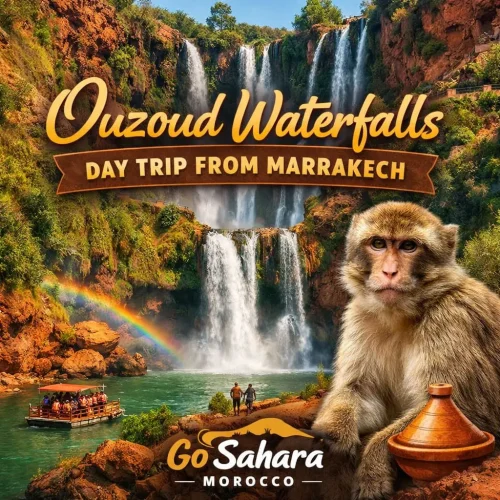
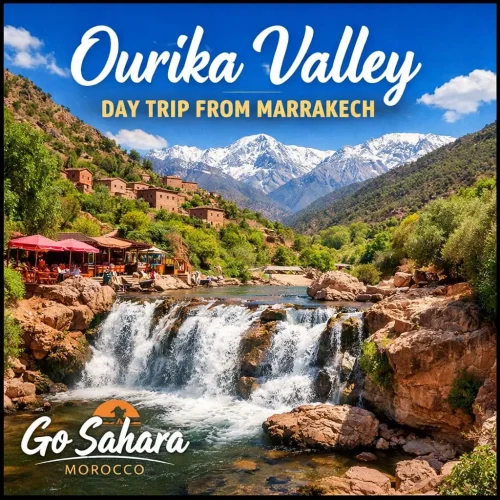
Explore More Day Trips from Marrakech
What Our Clients Say?
Real customer reviews


500+ reviews
Posted on TripadvisorVerified Mehdi the best driver Very good tour with Mehdi. He stopped in nice places so we could take pictures and did additional things that were not included in the tour for our enjoyment.Posted on TripadvisorVerified Must do tour !! Fantastic itinerary, fitting so much into 3 days. Todra Gorge & Sahara were the highlights, and Ayoub B was a great driver.Posted on TripadvisorVerified An Unforgettable Tour Led with Heart and Professionalism My experience on this tour was truly exceptional. Every detail was handled with care, and nothing was overlooked. Idris and Ngassa anticipated needs before they even arose and consistently ensured our safety and comfort.Their dedication felt like more than just a job — it felt like a true calling. They kept our group organized while still giving us the freedom to be ourselves. The pacing of each activity was perfect: engaging, well-balanced, and never overwhelming.The desert experience was absolutely phenomenal. The clear skies and beautiful weather made it unforgettable.I highly recommend this tour. Anyone who joins will not be disappointed.Posted on TripadvisorVerified Desert trip Ismael a great guide, friendly and attentive. Makes a good team with the driver too. An interesting experience for first time desert goers.Posted on TripadvisorVerified A great alternative route to Fez from Marrakech Ismail was a great tour guide. Stops on the road were well spread out and interesting. We were kept informed of the plan everyday and he made sure everyone was comfortable and got what they needed. It's a lot of time in the car (to be expected) and it was cold in the desert in December so plan accordingly!Posted on TripadvisorVerified Desert tour with great guides Yousef is the best super fun and knowledgeable he made the tour so special we had so much fun with him he was the life of the party and everything went well because of him and Jafar jafar os the best driver in Morocco this was my favourite experience here you have to do it !Posted on TripadvisorVerified Sahara in Style I had the most amazing Sahara trip with Morocco Tour! The guide, Moha, and the driver, Jaafar were great and treated me and everybody else on my tour like family. The stops made along the way towards the desert were led by local guides and were well thought out. The desert camp was the highlight of the trip, starting with arriving by camel. The tents were clean and modern, and had electricity along with hot water. Along with these amenities, there were other activities such as sand boarding and a sunrise atv ride. 10/10 would recommend to anybody who wants to see the Sahara and values excellent hospitality.
recognize
As Seen in & Inspired by Leading Travel Media